
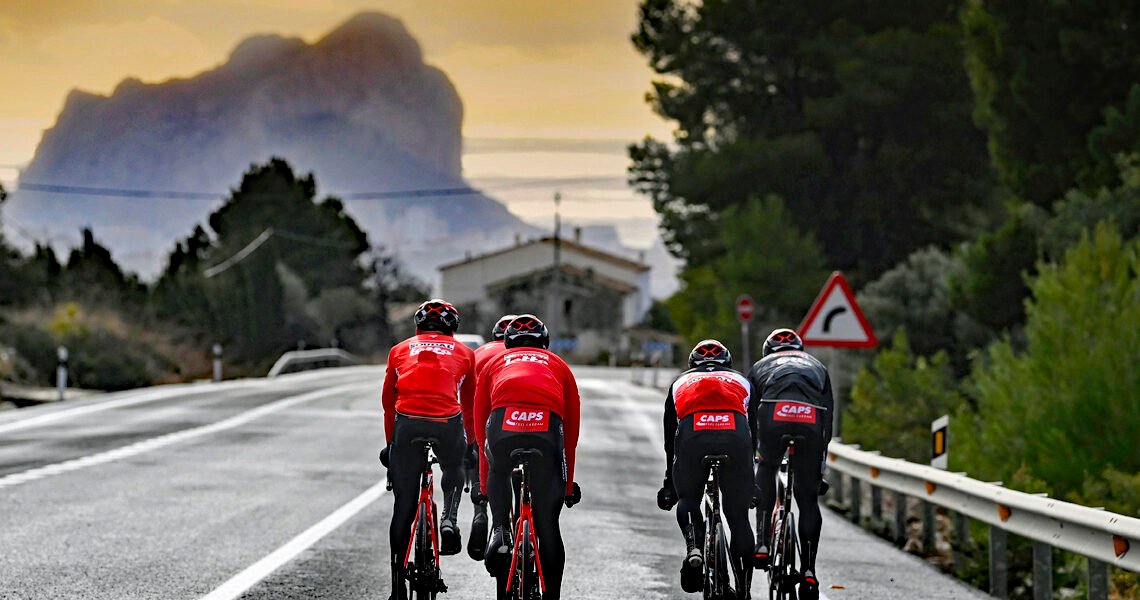

The off-season isn’t just about logging miles—it’s about rebuilding stronger for the season ahead. But here’s the catch: all the training in the world won’t make you faster if you’re not recovering properly. New research shows that poor recovery—especially sleep, stress, and fatigue—can significantly increase your risk of both injury and illness. For cyclists balancing hard efforts with real-world stress, learning to recover as seriously as you train may be the difference between peak performance and a season derailed.
~ We have all heard it enough times but it bears repeating because it’s so fundamental and so true: all the hard training you carefully plan comes to nothing without quality recovery that allows you to adapt to that stress.

You don’t want to get sick
Beyond impeding your ability to adapt and improve, it is also possible that poor recovery can bring all of your training progress and adaptation to a “crashing” halt by increasing your risk of illness or injury. The most obvious example of this comes from poor sleep or jet lag causing mental fatigue, with multiple studies demonstrating increased vehicle accident rates in the days immediately after season time changes.
On the field, a slight impairment of mental alertness can be enough to cause you to get hit differently as a rugby player. For a trail runner, that slight mental fog can cause you to not notice that root or divot on the ground. And for us cyclists riding in traffic or downhill, anything that reduces our focus is a recipe for disaster.
Athletes are also often on the razor-thin line between being at peak fitness and non-functional over-reaching, with heavy exercise volume/intensity lowering our immune function and inviting illness into our systems.

Time for a coffee ride
Horgan 2020
All of the above theory is great and all, but is there actual proof that non-optimal recovery increases our risk of injury and illness? An Australian research group sought to answer that question by retrospectively studying 536 elite and pre-elite female netball athletes (Horgan et al. 2021).
- The athletes were tracked over 4 years from 2015-2018, resulting in 263,847 total data entry points.
- The data came from the Australian Institute of Sport’s customized Athlete Management System, consisting of a combination of athlete self-report about training preparedness and illness completed prior to a training session, along with session training load completed afterwards. Medical records were used for injury occurrence.
- Examples of training preparedness variables include (on a scale of either 1-5 or 1-10): Fatigue, Mood, Motivation, Sleep Quality, Stress, and Soreness. Sleep duration to the nearest half hour was also recorded.
- Training load was quantified using s-RPE (Session Rating of Perceived Exertion) on a 1-10 scale, then used to calculate training strain, monotony, acute and chronic training load.
Was There an Association?
Before we proceed, while recognizing that self-report does have issues related to accuracy and self-bias, this is realistically the only way that such data could be obtained.
Overall, the daily probability for injury was 0.98%, while for illness is was 1.09%.
Since many of the variables are inter-related or overlap, they were statistically grouped into: 1) Psychological (stress, mood, and motivation), 2) Physiological (sleep quality, fatigue, sleep duration) and 3) Physical (soreness).
Similarly, training load was categorized into acute, chronic, and daily loads.
Overall, the analysis reported that there were distinct associations for both the 7 days and 28 days prior to injury or illness with these training preparedness variables. For the 7 day window, stress, soreness, fatigue, sleep duration, and sleep quality were significant predictors. Interestingly, increased motivation was also associated, which could signify athletes pushing themselves over the edge due to being really psyched to train/compete.
For the 28 day window, the main significant variables were an increase in soreness and changes to sleep quality.

What Should We Take Away?
I think that there are a few important lessons to take away from this study.
The first thing is that it is important to self-monitor your actual training preparedness each day. In addition to simply downloading the data, use your heart rate and power data, make it a habit to check in with yourself each morning and note down your psychological and physical perceptions. You can set up whatever system you want. It can be a simple 1-10 scale for each of psychological, physiological, and physical (soreness) sensations. Or to make things even simpler, just a single 1-10 global “training preparedness” score.
Doing this can help you not just track injury or illness, but flesh out your training notes. What caused this dip or rise in performance? How do you respond to a hard training block? This all helps with future planning.
Secondly, take the training preparedness data seriously. You don’t have to be a catastrophist and avoid hard training or a race solely based on your sensations of readiness to train. However, regularly monitoring your training readiness, along with understanding and listening to your body, is a critical skill for athletes to learn and adopt. Adapt your training and training environment as you are, rather than blindly following a schedule or pre-ordained workout.
Summary
Have fun and ride fast!

Enjoy your training
References
Horgan BG, Drew MK, Halson SL, et al (2021) Impaired recovery is associated with increased injury and illness: A retrospective study of 536 female netball athletes. Scandinavian Journal of Medicine & Science in Sports 31:691–701. https://doi.org/10.1111/sms.13866
Related on PEZ:
- Improve your training with better recovery strategies
- How heat and stress impact cycling performance
- The best tools and tech to track your training load
- Discover cycling destinations designed for performance and recovery
The post Why Cyclists Get Sick: The Hidden Cost of Poor Recovery appeared first on PezCycling News.